

EV Charging Charges in Australia: A Complete 2026 Breakdown
As Australia accelerates towards a sustainable transport future, the conversation is shifting from ‘if’ to ‘how’. For many new and prospective electric vehicle owners, one crucial question remains: what are the real running costs? The landscape of ev charging charges can seem complex, filled with varying home electricity tariffs, diverse public network fees, and the looming fear of an unexpected bill. This uncertainty can make it difficult to confidently compare the cost of a full charge to a full tank of petrol.
We believe in empowering every driver with complete confidence on their electric journey. This definitive 2026 breakdown is designed to provide that peace of mind by demystifying every aspect of EV charging costs in Australia. We will guide you through calculating your expenses, from leveraging off-peak rates at home to understanding the pricing at fast-charging stations. You'll gain actionable, future-proof strategies to minimise your costs, ensuring your transition to electric is both seamless and financially sound.
The Core Factors That Determine Your EV Charging Charges
One of the most common questions we hear is, "How much does it cost to charge an EV?" The answer isn't a single number, as your final ev charging charges depend on a dynamic set of variables. Understanding these factors provides the foundational knowledge to accurately calculate your costs and maximise your savings. The simplest way to think about it is by comparing it to a traditional petrol car: the cost of a full tank depends on the price of fuel, the size of your tank, and your car's fuel efficiency. For an EV, the principles are exactly the same.
Let's break down the three core components that empower you to calculate your charging costs with confidence.
Factor 1: Electricity Price (Cents per kWh)
The price you pay for electricity is the most significant variable. The unit of energy for an electric vehicle is the kilowatt-hour (kWh), which you can think of as the 'litre of electricity'. Understanding the kWh is central to grasping how EV charging station technology delivers power to your vehicle. In Australia, residential electricity rates typically range from A$0.25 to A$0.45 per kWh, but this can change based on your location, energy provider, and time of day. Charging during off-peak hours overnight is often cheaper, while leveraging your own solar power can bring the cost down to nearly zero.
Factor 2: Your EV's Battery Size (kWh)
Your vehicle's battery size, measured in kWh, is equivalent to the size of a fuel tank. It determines how much energy the car can store and, therefore, its maximum range. For example, a Tesla Model 3 has a battery of around 60 kWh, while a Hyundai Ioniq 5 is equipped with a larger 77 kWh battery. To calculate the cost of a full charge from empty, the formula is simple:
Formula: Battery Size (kWh) x Price per kWh (A$) = Cost for a Full Charge (A$)
Factor 3: Vehicle Efficiency (kWh per 100km)
Just like fuel economy in a petrol car, an EV's efficiency measures how much energy it consumes to travel a set distance. This is expressed as kWh per 100 kilometres (kWh/100km). A smaller, more aerodynamic EV might use just 14 kWh/100km, while a larger electric SUV could use over 20 kWh/100km. This metric is crucial for understanding real-world running costs.
Formula: Efficiency (kWh/100km) x Price per kWh (A$) = Cost to Drive 100km (A$)
Calculating Home EV Charging Charges: Your Biggest Savings Opportunity
For the vast majority of Australian EV drivers, the most significant savings are found right in their own garage. The latest industry data confirms that over 80% of charging occurs at home, giving you direct control over your vehicle's running costs. The key to unlocking these savings lies in understanding your electricity tariff and aligning your charging schedule with it. Your home energy plan is the single biggest factor influencing your ev charging charges.
Let's break down the common tariff structures and how they impact your wallet.
Charging on a Standard Flat-Rate Tariff
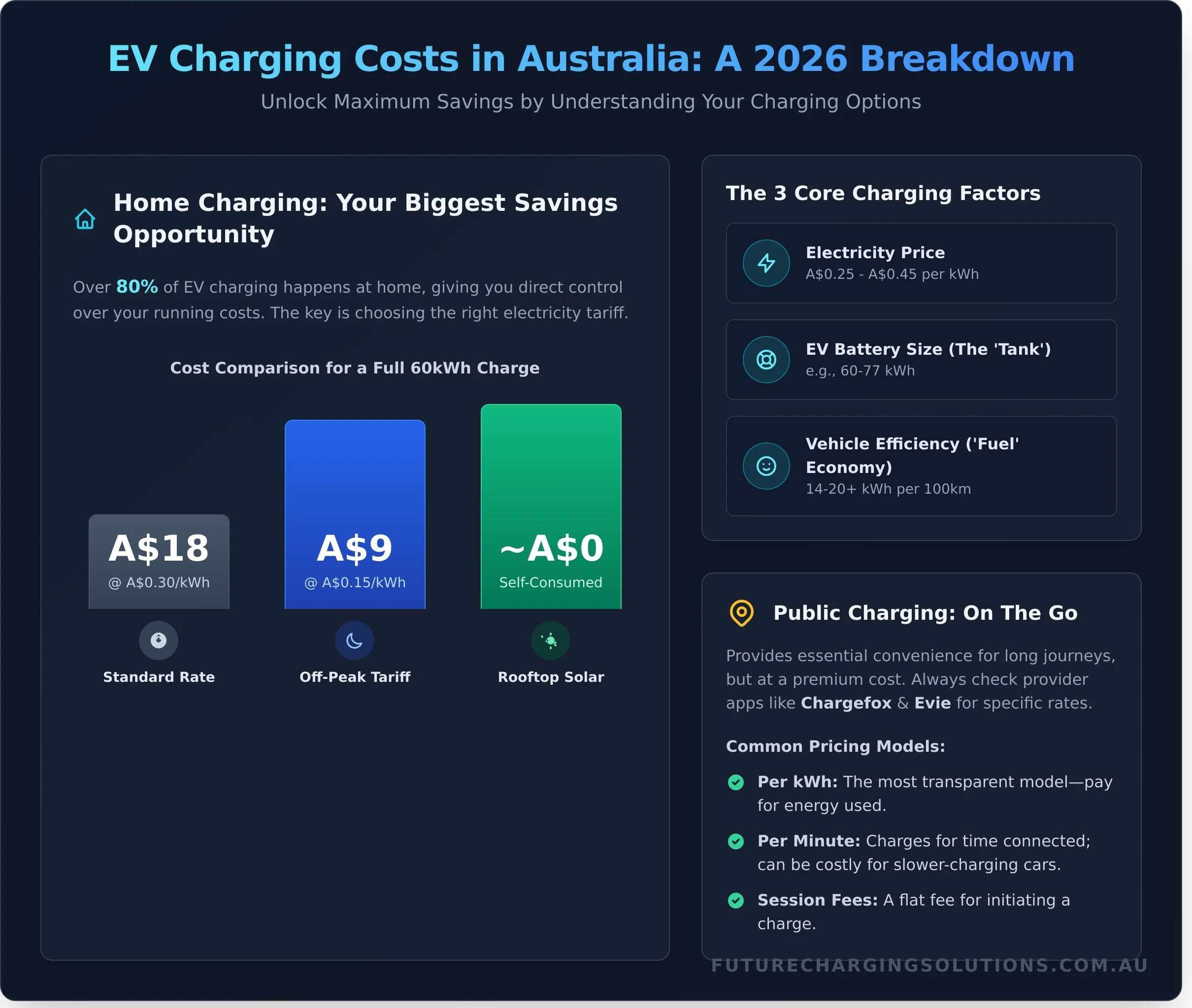
A single or flat-rate tariff is the simplest model: you pay the same price per kilowatt-hour (kWh) regardless of the time of day. While straightforward, it often means missing out on significant savings. For example, at a typical rate of A$0.30/kWh, a full 60kWh charge would cost A$18, or around A$4.50 per 100km.
Using Time-of-Use Tariffs to Your Advantage
This is where savvy EV owners can make a substantial impact. Time-of-Use (ToU) tariffs divide the day into different pricing periods:
Peak: Highest rates, typically 4 PM to 8 PM on weekdays (e.g., A$0.50/kWh).
Off-Peak: Lowest rates, usually overnight from 10 PM to 6 AM (e.g., A$0.15/kWh).
Shoulder: An intermediate rate for all other times.
By simply scheduling your charge for the off-peak window, that same 60kWh charge drops from A$30 during peak hours to just A$9 overnight. Modern smart chargers automate this process entirely, ensuring your vehicle only draws power when electricity is cheapest, delivering profound savings with zero effort.
Cost Comparison: 60kWh Full Charge
Standard Flat-Rate (@ A$0.30/kWh): A$18.00
Time-of-Use Off-Peak (@ A$0.15/kWh): A$9.00
Rooftop Solar (Self-Consumed): ~A$0.00
The Ultimate Saver: Charging with Your Own Solar Power
For the ultimate in cost-efficiency and sustainability, nothing beats powering your EV with your own rooftop solar system. By charging during the day, you use the 'self-consumed' energy your panels generate, which is effectively free. This reduces your home ev charging charges to nearly zero. Advanced smart chargers can even be configured to divert only excess solar power to your vehicle, maximising your energy independence and ensuring every kilowatt is put to good use. This is the future of sustainable, cost-effective transport.
Power your journey with the sun. Learn how we integrate solar with EV charging.
Public EV Charging Charges: Understanding the Costs on the Go
While home charging is the most economical option, public charging networks provide essential convenience for long journeys and drivers without dedicated home charging. Powering your vehicle on the go comes at a premium, but understanding the various public ev charging charges ensures you can make cost-effective decisions. In Australia, major networks like Chargefox and Evie dominate the landscape, each with distinct pricing structures. It is crucial to check the specific rate in the provider's app before you plug in to avoid any surprises.
Common Pricing Models: Per kWh, Per Minute & Session Fees
Public charging providers use several billing methods. Familiarising yourself with these models gives you complete confidence in your charging choices.
Per Kilowatt-hour (kWh): This is the most transparent method, where you pay directly for the amount of energy your vehicle receives. It is the fairest model, as you only pay for what you use.
Per Minute: This model charges you for the time your vehicle is connected. It can become expensive for EVs with slower charging capabilities, as you pay the same rate as a faster-charging car but receive less energy in the same timeframe.
Session & Idling Fees: Some networks add a small session connection fee (e.g., A$1.00) to initiate a charge. More importantly, be aware of idling fees, which are charged per minute if you leave your car connected after it has finished charging, encouraging you to free up the bay for the next driver.
AC 'Destination' Chargers vs. DC 'Fast' Chargers
The speed of the charger significantly impacts the cost. Slower AC chargers are ideal for longer stops, while rapid DC chargers are designed for quick top-ups.
Slower AC 'destination' chargers (7-22kW) are often found at shopping centres, hotels, and car parks. They are the most affordable public option, typically ranging from A$0.25 to A$0.40 per kWh. In contrast, DC 'fast' or 'ultra-rapid' chargers (50-350kW) are built for speed and are priced accordingly, usually between A$0.40 to A$0.85 per kWh. Use AC chargers when you have time to spare and DC chargers when you need to get back on the road quickly.
Are Charging Network Subscriptions Worth It?
For drivers who frequently rely on public charging, many networks offer subscription plans. These typically involve a monthly fee (e.g., A$10-A$15) in exchange for a discounted rate on your ev charging charges. For example, a subscription might lower your per-kWh cost from A$0.60 to A$0.45. This model provides significant savings for high-mileage drivers, road-trippers, and those without access to home charging, making it a forward-thinking investment in managing long-term running costs.
Workplace & Apartment Charging: Shared Costs and Solutions
As Australia accelerates its transition to electric vehicles, the demand for accessible charging infrastructure in shared spaces like offices and apartment complexes is growing exponentially. For businesses and body corporates, this presents both an opportunity and a challenge: how to provide reliable charging while managing costs fairly and equitably. At Future Charging Solutions, we specialise in designing and implementing tailored, end-to-end solutions that make shared charging simple, scalable, and future-proof, powering the future of your property.
Charging as an Employee Perk vs. a Paid Service
Forward-thinking companies are leveraging EV charging to enhance their value proposition and meet sustainability goals. They typically adopt one of two strategic models:
A Valued Employee Perk: Offering free charging is a powerful incentive to attract and retain top talent. It sends a clear message that your organisation is progressive, sustainable, and invested in its people's needs.
A Paid, User-Pays System: For businesses wanting to recover electricity costs or create a new revenue stream, smart charging systems provide a seamless solution. These platforms automatically manage all aspects of the ev charging charges, allowing employees to pay easily via a mobile app while the business recoups costs without any administrative burden.
Whichever model you choose, implementing workplace charging positions your organisation as a leader, ready for the electric future.
Managing Charges in Apartment & Strata Buildings
The primary concern for strata committees is ensuring that the cost of charging an EV is billed directly to the user, not subsidised by all residents through common power bills. Modern smart charging infrastructure completely solves this complex issue. Through sophisticated load management systems, we ensure the building’s power supply is never overloaded, even as more residents switch to EVs. Each charging session is individually metered and billed directly to the resident's account, providing complete transparency and fairness for everyone.
This approach eliminates billing disputes, provides residents with the ultimate convenience of at-home charging, and significantly increases the long-term value and appeal of your property. We provide complete peace of mind by handling everything from the initial assessment to ongoing management. We design custom strata charging solutions. Get a free assessment.
Actionable Strategies to Minimise Your EV Charging Charges
Owning an electric vehicle is not just about sustainable driving; it's about smart energy management. As your partner in powering the future of mobility, we want to empower you with the knowledge to significantly reduce your ev charging charges. This expert guide provides practical, easy-to-follow strategies to ensure you're charging your vehicle in the most cost-effective way possible, giving you complete confidence and peace of mind.
By adopting a few smart habits, you can take full control of your running costs. Here is our checklist for becoming a savvy EV owner.
At Home: Smart Scheduling and Solar
Your home is your primary and most affordable charging location. Optimising your setup here yields the biggest savings.
Charge During Off-Peak Hours: Most Australian energy retailers offer 'time-of-use' tariffs with much cheaper electricity rates overnight, typically between 10 pm and 7 am. Scheduling your charging for these windows can cut your costs by more than half.
Invest in a Smart Charger: A smart charger automates the process of off-peak charging. You can simply plug in when you get home and program the charger to begin only when the cheaper rates kick in, providing a seamless, hassle-free experience.
Leverage Your Solar Power: If you have a home solar system, a solar-aware smart charger is the ultimate tool. It can be configured to direct excess, free energy from your panels straight into your car battery before exporting to the grid.
On the Road: Plan Your Public Charging
While public charging is essential for long trips, a little planning can prevent unnecessary expenses.
Use Apps to Compare Prices: Before you plug in, use an app like PlugShare to check and compare the pricing of nearby stations. Rates can vary significantly between different charging networks.
Use DC Fast Chargers Wisely: Ultra-fast DC chargers are fantastic for long-distance travel but are the most expensive option. For a small daily top-up, a cheaper AC charger at a shopping centre or destination is often a more economical choice.
Know Your Vehicle's Limits: If your EV’s maximum charging speed is 100kW, you won't gain any benefit from using a 350kW charger. You’ll simply be paying a premium rate for speed your car cannot use.
Vehicle Maintenance and Driving Habits
How you drive and maintain your EV has a direct impact on its energy consumption and, consequently, your overall ev charging charges.
Maintain Correct Tyre Pressure: Under-inflated tyres increase rolling resistance, forcing your motor to work harder and use more energy. Check your tyre pressure monthly.
Adopt a Smooth Driving Style: Harsh acceleration and braking consume significantly more battery power. Gentle, smooth driving and making full use of regenerative braking will extend your range.
Moderate Your Climate Control: The heating and air conditioning systems draw power directly from the main battery. Pre-heating or pre-cooling the cabin while the car is still plugged in can help conserve range on the road.
For expert advice on creating a seamless and future-proof home charging infrastructure, including smart chargers and solar integration, explore our tailored solutions and let's shape a more efficient future together.
Your Roadmap to Mastering EV Charging Charges in Australia
As we've explored, understanding the variables behind your ev charging charges is the key to unlocking the full financial benefits of driving electric in Australia. The most significant takeaway is clear: charging at home, especially when paired with off-peak electricity tariffs or a home solar system, presents your greatest opportunity for savings. While public and workplace options offer crucial convenience, a tailored home setup gives you ultimate control over your running costs.
This is where expert guidance makes all the difference. As an independent provider of complete end-to-end solutions, Future Charging Solutions specialises in designing and installing future-proof, scalable systems for residential, commercial, and strata properties. We provide the peace of mind that comes from a seamless, professional installation designed for long-term performance.
Ready to unlock the savings of smart home charging? Book Your Free Consultation with Future Charging Solutions. Let's power your journey towards a more sustainable and cost-effective driving future.
-
Yes, charging an electric vehicle is significantly cheaper than refuelling a petrol car in Australia. For every 100 kilometres driven, a typical petrol car can cost A$15-A$20. In contrast, charging an EV at home on a standard electricity tariff costs only around A$4-A$6 for the same distance. This presents a substantial long-term saving, empowering you to drive more efficiently and sustainably while reducing your running costs.
-
The cost to fully charge a Tesla Model 3 depends on its battery size and where you charge it. A Model 3 Standard Range (approx. 60kWh battery) charged at home on an off-peak tariff of A$0.15/kWh would cost about A$9. Using a public DC fast charger at A$0.60/kWh, the same charge would be around A$36. Planning your charging strategy is key to maximising your savings and convenience.
-
Description text goes hereWhile not typically "hidden," public networks may have additional costs beyond the energy rate. These can include session initiation fees, monthly subscription fees for preferential rates, or idle fees if your vehicle remains plugged in after charging is complete. To ensure full transparency, we always recommend reviewing the pricing structure within the network's mobile app before you begin a session. This gives you complete confidence and control over your expenses.
-
The increase depends on your driving distance and electricity plan. An average Australian driver covering 13,000 km per year will use approximately 2,000 kWh of energy. On a standard A$0.30/kWh tariff, this adds around A$50 to your monthly bill. By utilising smart charging schedules to access off-peak rates or leveraging a home solar system, you can significantly lower this impact and further enhance your savings.
-
Yes, you can find free EV charging stations, often provided as an amenity to attract customers. These are commonly located at shopping centres, hotels, wineries, and some local council car parks. While these chargers are typically slower AC units ideal for topping up, they offer a fantastic, cost-free benefit. We recommend using apps like PlugShare to locate these opportunities and integrate them into your travel plans.
-
Item descriptionA "tariff" refers to the rate your home electricity provider charges per kilowatt-hour (kWh). In contrast, an EV charging charge is the price set by a public charging network for using their equipment. This public charge can be structured per kWh, per minute, or as a flat fee per session. Understanding this difference is fundamental to managing the overall cost of powering your electric vehicle both at home and on the road.
-
Paying at public stations is designed to be a seamless, hassle-free process. The most common method is via a dedicated smartphone app from the charging network, where you link your credit or debit card. Many modern DC fast chargers also offer direct tap-and-go payment with a credit card, while some networks provide a scannable RFID card for members. This ensures you can power your journey with ease and confidence.
