

Key Proposed EV Charging Changes in NCC 2025 Every Builder Needs to Know
The proposed NCC 2025 builds on NCC 2022 by introducing stronger requirements for energy efficiency, electrification, and EV readiness. Key changes include mandatory provision for EV charging infrastructure in new developments, stricter energy and greenhouse gas performance standards, and measures to future-proof buildings for low-emission technologies. It also tightens rules around fire safety, condensation management, and integration of building services, reflecting a shift toward sustainable, low-carbon, and future-ready construction.
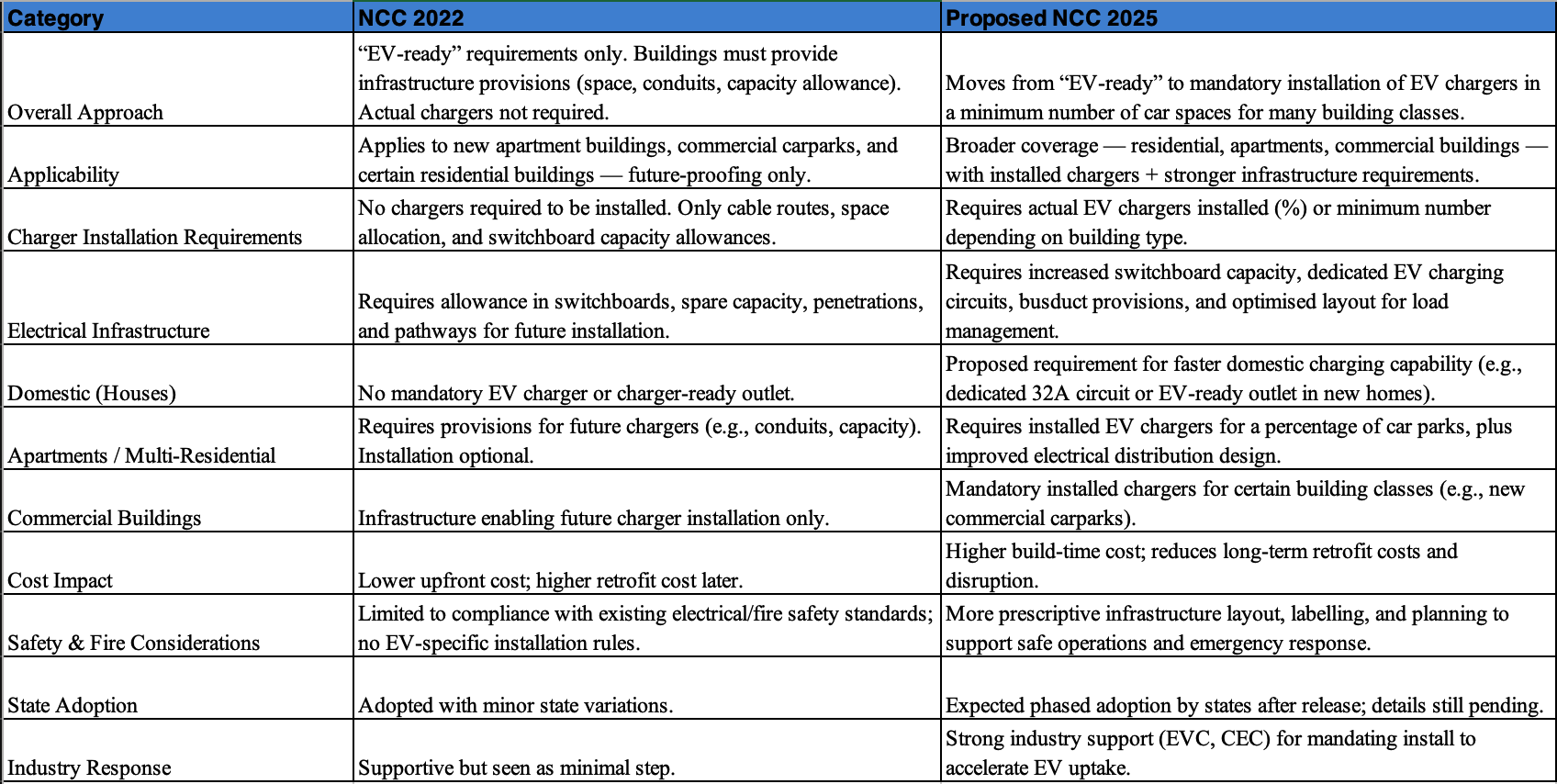
Below is a simple and structured comparison of NCC 2022 vs NCC 2025, followed by a practical table to help you plan your project as a builder/ developer.
Quick comparison — NCC 2022 vs proposed NCC 2025 (EV charging)
Below is a focused, actionable comparison using ABCB and industry guidance (key sources cited inline at the end).
1) Overall approach
NCC 2022: Requires buildings to be “EV-ready” / provide facilities for future EV chargers — e.g., space for switchboards, spare capacity/conduits, and basic infrastructure provisions (Part J9D4). It does not mandate installing actual chargers. National Construction Code
Proposed NCC 2025: Moves from “EV-ready” to requiring actual EV charging equipment in a minimum number of parking spaces for many building types, plus stronger electrical infrastructure requirements to support that equipment. (The PCD guidance explicitly states the 2025 draft mandates installation for a minimum number of carparks). DCCEEW+1
2) Which buildings / parking spaces are affected
NCC 2022: Focus on ensuring facilities in new builds where people live or frequently visit (apartments, commercial carparks) — it requires provision for future infrastructure but leaves installation decisions to owners/users and jurisdictions. Some state rollout/interpretation differences exist. National Construction Code+1
Proposed NCC 2025: Broadens and tightens coverage — proposes mandatory installed chargers (or minimum installed proportions) for many building classes (residential buildings, apartments, commercial buildings) and tighter requirements for switchboard capacity and EV charging points in homes. Exact percentages/thresholds vary by clause and are set out in the PCD guidance. DCCEEW+1
3) Electrical infrastructure & technical requirements
NCC 2022: Requires space/provisions such as room for switchboards, allowance for additional circuits, conduit routes and basic provisioning to make future connector/charger installation less disruptive. It relies on electrical standards (AS/NZS 3000, etc.) for installations. National Construction Code+1
Proposed NCC 2025: Tightens electrical requirements, including:
4) On-site charger installation (who pays / who installs)
NCC 2022: Does not require owners to install chargers — it only reduces the cost/hassle later by requiring ducting/switchboard space. Installation is typically an owner/resident decision and falls under electrical contractor rules and AS/NZS standards. National Construction Code
Proposed NCC 2025: Would require a minimum number of chargers to be installed at construction, shifting some upfront cost to developers / builders (or requiring them to deliver spaces already fitted with chargers). The PCD guidance frames this as the next step to accelerate EV uptake. Implementation detail (e.g., exact minimums, who bears cost) depends on final clauses and possible state adaptations. DCCEEW
5) Safety, fire & emergency responder considerations
NCC 2022: Advisory guidance exists (ABCB advisory notes, fire authority inputs); fire-safety specifics for EVs are handled through other standards and guidance rather than being deeply prescriptive in the 2022 code. National Construction Code
Proposed NCC 2025: The PCD and submissions note safety is considered (electrical distribution design, labeling, segregation). Stakeholders (e.g., fire/emergency bodies) requested clearer requirements for responder safety; these discussions influenced drafting but detailed operational fire-safety measures may remain in supporting guidance and standards rather than prescriptive code clauses. EV Council
When Will NCC 2025 Take Effect? Although NCC 2025 is expected to be published by February 2026, most residential changes—including mandatory EV charging for new homes—have been paused until mid‑2029 following an October 2025 agreement by Building Ministers. Jurisdictions may begin adopting the new code from May 2026.
Some provisions affecting commercial and multi-residential buildings may still proceed, so it’s crucial for developers and builders to stay informed and prepared. Early readiness will help ensure compliance and minimise future costs, even if the rules are adjusted before formal adoption.
When Will NCC 2025 Take Effect? Although NCC 2025 is expected to be published by February 2026, most residential changes—including mandatory EV charging for new homes—have been paused until mid‑2029 following an October 2025 agreement by Building Ministers. Jurisdictions may begin adopting the new code from May 2026.
Some provisions affecting commercial and multi-residential buildings may still proceed, so it’s crucial for developers and builders to stay informed and prepared. Early readiness will help ensure compliance and minimise future costs, even if the rules are adjusted before formal adoption.
