FUTURE CHARGING SOLUTIONS · FLEET & DEPOT
Your fleet.
Your future.
Fully charged.
EV charging designed around your operations. From your first electric vehicle to a growing fleet, we match charging to your vehicles, schedules and site capacity.
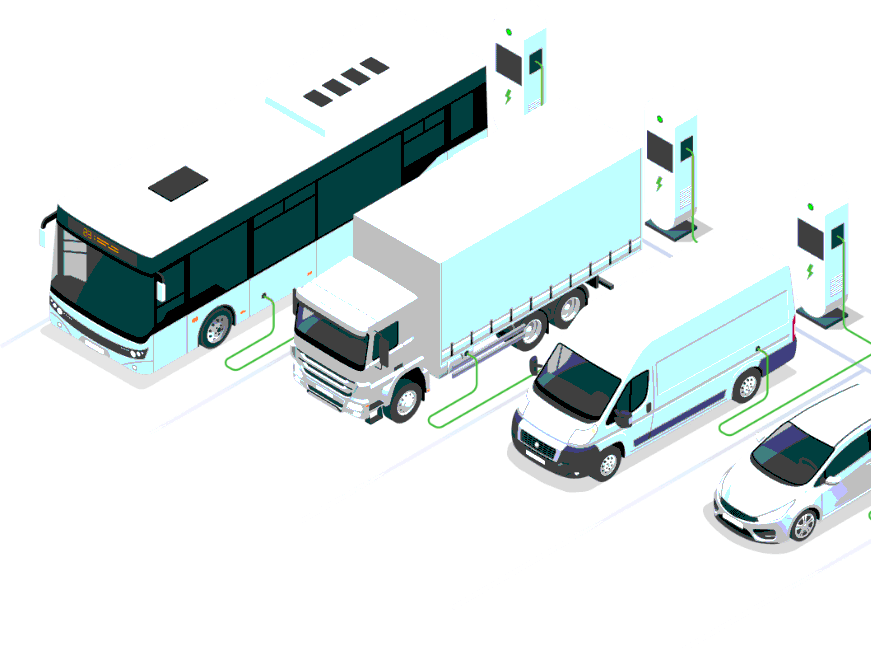
YOUR VEHICLES. YOUR WORKING DAY.
Fleet charging starts with how you operate
Start with the working day: where vehicles park, how long they stay and the journeys they need to complete next.
Business & service fleets
Company cars, trade vehicles and field teams. Match workplace or depot charging to variable return times, shared parking and driver access.
Delivery & logistics
Vans, trucks and distribution sites. Fit charging around loading, vehicle movements and dispatch times, including the busiest operating days.
Council & operational fleets
Pool cars, maintenance vehicles and community transport. Plan across vehicle types and sites, with clear priorities for vehicles needed at short notice.
CHARGING BUILT AROUND YOU
Match charging to the time you have
Overnight depot charging
AC charging can suit cars and vans parked overnight. Size it around daily energy use, the available charging window and each vehicle’s AC charging limit.
Rapid turnaround
DC charging can suit shorter breaks or higher energy needs. Actual charging speed depends on the vehicle, battery conditions and available site power.
Mixed & growing fleets
Combine AC for routine parking with DC where faster top-ups are needed. Plan shared infrastructure now and add chargers as electric vehicles arrive.
Start with energy, then choose power
Energy to replace (kWh) ÷ usable charging time (hours) = average power needed (kW).
This is a starting estimate. Final sizing also accounts for charging losses, vehicle limits, overlapping charging sessions and operational reserve.

START WITH A CLEAR PLAN
Know what your depot can support
Turn fleet requirements and site constraints into a practical first stage, with a clear path for the vehicles that follow.
- Charging plan: energy needs, charging windows and a suitable AC/DC mix
- Site readiness: available power, parking layout, cable routes and upgrade requirements
- Initial scope: charger numbers, locations, load management and project cost estimates
- Expansion path: infrastructure to prepare now and dependencies to resolve before rollout
MAKE YOUR SITE CAPACITY WORK HARDER
Smart charging for a busy depot
Charging shares power with the rest of your site. The controls need to balance that demand with the vehicles due to leave next.
Manage available power
Dynamic load management shares available capacity as site demand changes. Individual vehicles may charge more slowly, so the plan must still meet their departure requirements.
Plan when vehicles charge
Where supported, prioritise earlier departures and schedule flexible charging around your tariff. The aim is to manage costs while keeping the next shift ready.
Consider solar & storage
Direct solar charging works best when vehicles are parked during generation. Assess storage against your charging schedule, site constraints and the additional investment required.
Control features depend on the selected equipment and platform. Site assessment determines whether power upgrades are needed.
A CLEARER INVESTMENT DECISION
Look beyond the charger price
Budget for the complete charging system, from installation through ongoing operation and expansion.
Site & installation costs
Switchboard capacity, cable distances, trenching, civil works, communications and any required supply upgrades all influence the project cost.
Operating costs
Allow for electricity, applicable demand charges, software subscriptions, connectivity and maintenance. Costs vary with your tariff, usage and selected service arrangements.
Expansion over time
Separate what your first vehicles need from infrastructure worth preparing for later. Review power capacity as vehicle numbers and operating patterns change.
From first discussion to operational charging
Understand your fleet
Vehicles, routes, shift times and growth plans.
Assess & design
Site capacity, charger selection and staged costs.
Install & commission
Coordinate works with licensed electricians, commission chargers and train users.
Support & optimise
Monitoring, maintenance and performance reviews.
ONE PARTNER THROUGHOUT THE ROLLOUT
Independent advice. Support beyond installation.
FCS brings assessment, design, supply, installation coordination and ongoing support together. Independent brand selection lets us match the equipment to your fleet and site.
Choose compatible systems
Check vehicle compatibility, software requirements and communications before purchase. Open protocols can support platform choice, with integration confirmed for the selected system.
Make handover practical
Commissioning and user training prepare your team for daily operation. Agree who plugs in vehicles, manages access and responds when charging needs attention.
Keep performance in view
Choose monitoring and maintenance arrangements that suit your operation. Confirm the available reporting, support responsibilities and response arrangements with your selected package.
Flexible ways to fund your rollout
Explore finance, rental and Charging-as-a-Service options to suit your project and budget.
Explore finance options →SUPPORT FOR YOUR TRANSITION
Funding opportunities for fleet electrification
Program status can change. Check official details before planning an application.
NSW Competitive Bid — Round 7
Initial bids for Round 7 have closed. Participating organisations will be contacted by the department.
Check the official program page for updates.
Official details ↗NSW Kick-start — Round 2
For eligible smaller fleets and pilot transitions, including qualifying taxi and truck operators.
Vehicle incentives with optional charging support. Charger funding requires a vehicle-incentive application.
Official details ↗ARENA Driving the Nation
For qualifying heavy electric vehicle, heavy-vehicle charging, V2G and innovation projects.
Discuss your project with ARENA before submitting an expression of interest.
Official details ↗*The Kick-start waitlist may close earlier. FCS can support charging assessments, design and project costing. Grant approval is determined by the funding body.
Fleet charging questions
Do we need a charger for every vehicle?
Not always. Charger sharing depends on parking windows, energy needs and whether vehicles can be moved between bays. Dedicated charging points may simplify operations when vehicles return and leave together.
Can we start with a small pilot?
Yes. Start with a defined vehicle group, then review energy use, charging completion and driver routines. Plan shared infrastructure for later stages so the pilot informs your wider rollout.
Will our depot need an electrical upgrade?
A site assessment compares available power with fleet demand and charging windows. Managed charging or staging may defer upgrades; tighter schedules or higher energy needs may still require additional supply.
How do we plan for a charger being unavailable?
Include a fallback in the operating plan: access to another suitable charger, a revised charging schedule or an agreed external option. Confirm maintenance responsibilities and fault reporting before launch.
Can we control access and track charging use?
Compatible systems can provide driver access controls and session records. Confirm the access methods, reporting and cost allocation you need when selecting the platform.
Can a grant fund chargers without new vehicles?
NSW Kick-start charging support requires a vehicle-incentive application. Other programs have their own eligibility rules, so each project needs to be assessed individually.
What information should we prepare?
Vehicle types and numbers, typical and busiest-day kilometres, arrival and departure times, site locations, electricity bills and available switchboard drawings. Include your planned vehicle replacement dates.

Let’s plan your fleet charging rollout
Tell us your fleet size, vehicle types, depot location and transition timing.

EV Charging for Fleet Management
Empowering Your Transition to Future-Ready Fleet
As more companies—and the logistics and transport sectors—accelerate their transition to electric vehicles, the demand for reliable, scalable, and cost-effective charging infrastructure is growing rapidly.
At Future Charging Solutions, we partner with fleet operators, logistics providers, commercial businesses, and government agencies to deliver tailored EV charging systems that align with operational requirements, energy management strategies, and long-term sustainability goals.
Fleet electrification is more than just a technological upgrade — it’s a strategic shift. With smart planning, intelligent energy use, and robust infrastructure, businesses can reduce operating costs, minimise downtime, and meaningfully advance their ESG commitments.
Our EV charging solutions are purpose-built to support diverse fleet types — from light commercial vehicles and delivery vans to heavy-duty trucks and depot-based operations — with a strong focus on integration, reliability, and future scalability.
Everything You Need for EV Charging — All in One Place :
End-to-End Infrastructure Design & Deployment :From site assessments and network capacity planning to installation and commissioning, we manage every stage of your EV charging rollout to ensure operational continuity and minimal disruption.
Smart Energy & Load Management: We implement dynamic load balancing and energy optimisation software that ensures efficient use of existing electrical infrastructure — reducing peak demand costs and enhancing grid stability.
Scalable Charging Systems: We offer modular AC and DC charging systems (7kW to 350kW), fully OCPP-compliant and suited for depot charging, public access, or workplace use — ready to scale with your fleet growth.
Monitoring, Reporting & Analytics: Gain access to advanced dashboards that track energy usage, charger availability, cost efficiency, and emissions data — supporting compliance and strategic decision-making.
Ongoing Maintenance & Technical Support: Our Australian-based support team provides remote diagnostics, scheduled servicing, and rapid response options to ensure high uptime across all sites.
Who We Serve
Transport & Logistics companies with delivery vans or trucks
Government fleets (council vehicles, maintenance fleets)
Corporate fleets (sales teams, service vehicles)
Public transport operators with electric buses or shuttles
Warehousing & Distribution with delivery vans or trucks

Ready to Power Your Fleet with EV Charging?
-

Step 1- Free consultation
We begin with a dedicated consultation to understand your operational goals and how EV charging integrates into your fleet or workplace environment. Whether you're transitioning delivery vans, service vehicles, company cars, or setting up charging at a depot, warehouse, or office site, we take the time to assess your vehicle usage, parking arrangements, shift patterns, and future fleet plans.
This allows us to recommend practical, scalable EV charging strategies that minimise disruption to operations and align with your business priorities — from cost control to sustainability targets. -

Step 2- Charging Needs & Site Assessment
Following the consultation, we carry out a detailed on-site assessment to evaluate both your charging needs and existing infrastructure. For fleet and workplace environments, we consider factors such as the number of vehicles, dwell time, operational schedules (e.g. overnight or shift-based charging), and the potential for future expansion. Our team reviews switchboard capacity, circuit availability, cable routing, and space constraints to ensure chargers are installed efficiently and safely. Where needed, we conduct a feasibility study to confirm the site’s readiness for current and future demand.
-

Step 3- Design the Solution
Based on your charging needs and site assessment, we develop a customised EV charging solution tailored to your operations. This includes selecting the right charger type (AC or DC chargers), the most suitable brand and model , determining optimal charger locations, and integrating smart features like load management, scheduling, and remote monitoring.
We also design for future scalability — whether you're starting with a few chargers or planning a full fleet transition. Our goal is to deliver a safe, efficient, and future-proof system that aligns with your workflow, site constraints, and energy capacity. -

Step 4- Supply and Install
Once the design is approved, our certified installation team gets to work. We coordinate with your site managers or facility teams to ensure a smooth installation process with minimal disruption to daily operations.
We manage all aspects — from electrical upgrades and trenching (if needed), to hardware installation, software setup, and network integration. After installation, we thoroughly test and commission the system to ensure it’s safe, compliant, and fully operational. We also provide user training, documentation, and support to help your team get up and running confidently.
⚡ Don’t Want to Pay Everything Upfront? No Problem.
We offer flexible options to suit your budget — including Charging-as-a-Service (CaaS), rental plans, and finance solutions. Get in touch to learn more!
Three Strategic Things to Get Right Before You Plug In:
1. What’s the Purpose of the Charging Infrastructure?
Is it for your own fleet? Staff vehicles? Visitors or customers? Defining who you’re charging and when (overnight, during the day, rapid turnaround?) shapes everything from charger type to layout and energy needs.
2. Can Your Site (and Power Supply) Handle It?
Before anything is installed, you’ll need to assess your current electrical capacity, parking layout, and future demand. Smart solutions like load management and staged rollouts can help you work within limits and avoid expensive upgrades.
3. How Will This Evolve Over Time?
EV demand is only growing — so your infrastructure should be flexible and scalable. Plan for what you need now, but design with future expansion in mind. It’s more cost-effective to build the foundation right from the start.
Awards, Accreditations & Industry Memberships