V2G & V2H, Bidirectional EV Charging : What It Means
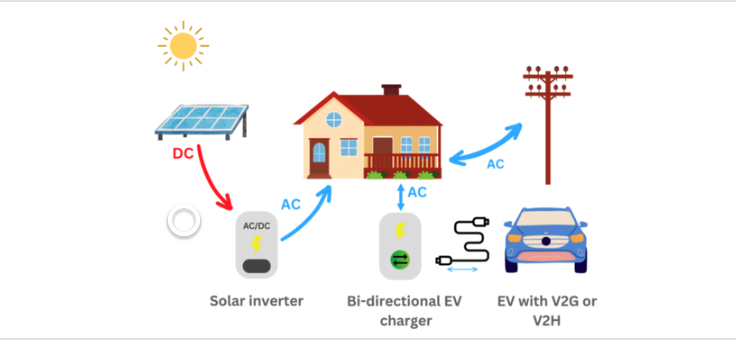
As the electric vehicle (EV) market continues to grow across Australia, so does interest in bidirectional charging — a technology that allows EVs to do more than just drive and charge.
Instead of only consuming electricity, EVs can now store and return energy, acting as mobile batteries that can support homes, buildings, and even the grid.
But how practical is this in Australia today? Let’s break it down.
What is Bidirectional EV Charging?
Bidirectional EV charging allows electricity to flow in two directions:
Grid → Vehicle (charging your car)
Vehicle → Home / Building / Grid (sending energy back)
In simple terms, your EV becomes a battery on wheels — capable of storing energy when it’s cheap or generated from solar, and using it later when it’s needed.
What is V2G (Vehicle-to-Grid)?
Vehicle-to-Grid (V2G) allows your EV to send electricity back into the power grid.
👉 This means your EV can:
Support the grid during peak demand
Help balance energy supply
Potentially generate revenue in future energy programs
Instead of sitting idle, your vehicle becomes part of the energy network.
What is V2H (Vehicle-to-Home)?
Vehicle-to-Home (V2H) allows your EV to power your home directly.
👉 This can be used for:
Backup power during outages
Reducing electricity bills during peak pricing
Storing and using excess solar energy
In this setup, your EV effectively acts as a home battery system.
What’s the Status in Australia Today?
V2H – Emerging and Becoming More Practical
V2H is becoming increasingly viable in Australia, particularly for:
Residential backup power
Solar energy optimisation
👉 The key shift:
More manufacturers are now developing bidirectional-ready vehicles, meaning wider availability is expected in the near future.
V2G – Still in Pilot Phase, But Progressing
V2G remains in the early stages in Australia, but momentum is building.
Pilot programs are ongoing with energy providers
DNSPs (Distribution Network Service Providers) are developing approval pathways
Standards and grid integration requirements are evolving
At present:
V2G is not yet widely approved for general use
Most deployments are limited to trials and specific use cases
👉 However, as EV adoption increases, V2G is expected to become a key part of Australia’s energy system.
What’s Changing in the Market?
The biggest shift is:
👉 EVs are becoming part of the energy ecosystem
Automakers are preparing for bidirectional capability (via CCS2 and ISO 15118 updates)
Energy providers are exploring EVs as distributed energy storage
Charging infrastructure is becoming smarter and more integrated
👉 Over the next 1–3 years, we expect:
More compatible EVs
More approved bidirectional chargers
Clearer regulations
Broader use in homes, apartments, and commercial sites
How Much Do Bidirectional EV Chargers Cost in Australia?
Bidirectional EV chargers are still relatively limited in the Australian market, and as a result, pricing remains higher compared to standard one-way chargers. At present, bidirectional-capable systems typically range from $6,000 to $12,000 AUD (supply only) for AC or lower-power DC units, with total installed costs increasing depending on site complexity and electrical requirements.
However, there is a well-known European brands, as Zaptec (Zaptec Pro, Zaptec Go 2), that offer more cost-effective smart charging solutions. While these chargers are not yet fully enabled for bidirectional use in Australia, they are designed with future-ready capabilities, making them a practical and economical option for current installations while allowing for potential upgrades as the market evolves.
Can I Install a bidirectional Charger Now?
Yes — EV chargers can be installed today and used as standard (one-way) chargers without any issues. This allows clients to start benefiting from EV charging immediately while demand continues to grow.
However, it is important to understand that bidirectional functionality (such as V2H or V2G) is still emerging in Australia. If you wish to enable these capabilities in the future, additional upgrades may be required. These can include integration with energy management systems, updates to electrical infrastructure, and approvals from the local network provider.
👉 In other words, while the charger can be installed and used straight away, activating bidirectional capability in the future is required — it typically involves further technical and regulatory steps.
Get the charger NOW and Upgrade later !
We Can Help
At Future Charging Solutions, we stay on top of the latest EV charging technologies — including bidirectional charging. Whether you're planning an installation today or preparing for future V2G/V2H capability, we can help you design a solution that's smart, scalable, and standards-compliant.
📩 Get in touch via Landline (1300 490 128) , Mobile ( 0483 918 102) or Email (enquiry@futurecharging.com.au) to learn more about these chargers or for upcoming bidirectional pilot programs.